Page 9 of 20

Because I was asked…

I recently received an e-mail saying that I now have 60 or so credits from a college that is losing accreditation:

The school [City College of San Francisco], the largest college in California, was notified last week by the Accrediting Commission for Community and Junior Colleges that it will lose accreditation on July 31, 2014, leaving students without federal financial aid and potentially voiding their ability to transfer credits to other schools.

http://www.huffingtonpost.com/2013/07/09/city-college-of-san-francisco-protest_n_3569046.html

The e-mail came from CCSF itself and they asked me to both tweet and write to a journalist about how important CCSF has been for me as a successful transfer student. Luckily, I transferred just under a year ago, which provides me with insight into how the school was operating while the pressure was on as well as what it has meant to me.

To start, it has, most definitely, changed my life in a significant way that I truly appreciate. I decided to go to college at 29 because I was having difficulty finding any work at all, let alone rewarding work, and found myself in a state where I could get an education for free. That second part is important. Because I was an independent student and a citizen of California with very little income, I qualified for the Board of Governor’s Waiver which paid for my tuition in full. I may have never gone if it hadn’t been for this benefit.

The education I received there was also, for the most part, just as good as what I receive at Tulane University now. In fact, my Spanish classes there were all far superior to the various languages classes I’ve taken at Tulane. The student population was also extremely diverse and interesting. I was never the oldest person in my classes. The school really did fill a lot of roles for a lot of people.

I’m not writing to that journalist, though. I don’t think he’d want me to anyway because I couldn’t say that I’m against the school losing accreditation. I remember hearing about this often for the last couple semesters I was there. The infrastructure was in shambles. I shivered through plenty of “summer” night classes in the Creative Arts building and I’m pretty sure they tried to cut back on costs by not providing paper towels in the bathrooms (which is both a minor issue for a student and a minor effort on the school’s part). The “offices” for faculty were often sectioned off makeshift cubicles in large rooms with giant stacks of paperwork functioning as supports. There were at most two financial aid clerks working during fairly limited hours that left slow-moving lines of up to 100 students at a time waiting to have a couple questions answered or a form signed. No one in the school could be reached by phone and you would be very lucky to receive a response to an e-mail that wasn’t sent to a professor. And what if you tried to get some of your bureaucratic formalities out of the way early before the rush of students made it a nightmare in the early semester? They’d tell you it’s too early and you’d have to come back. My guess is this was probably because they didn’t have the faculty to do anything with it at that time anyway.

Professors, though most of the ones I had (carefully) selected were rather good, often brought the politics of the school to the classroom. I was regularly asked by teachers to make sure that I voted for more bonds to be issued and whatnot, anything that would superficially provide the (possibly insolvent) school with more funds. In fact, my favorite teacher once complained–although she also had a sense of concern in her delivery–that she and others were forced to forgo raises so that other teachers with less time in wouldn’t be laid off. And I understood their concerns, but I didn’t automatically assume that the problem was simply not enough money being pumped in, especially given statements like that last one. I mean, they had a very poor faculty-to-student ratio but at the same time almost the entirety of their operating costs went to faculty salaries. To be fair, the ratio is a problem for most CA school and I couldn’t verify what a normal percentage of costs for faculty would be, but it was enough that it didn’t feel appropriate to bring the politics into the classroom so regularly.

That’s not to say the students weren’t equally ridiculous about the issue. CCSF has possibly the lowest tuition rates in the country for a community college [my guess] and they were very slowly increasing due to the crisis. Simultaneously, students would come into my classes–often those involved in the Occupy movement–speaking about how the original plan for CCSF was for it to be literally free for everyone. They were up in arms about the tuition hikes and the shorter semesters and the cuts in class availability (because CCSF was at least doing a little to try to lower their bottom line).

It was an impossible scenario where you have both a mismanaged school and an unrealistic student body attempting to maintain some pipe-dream where education is free and no one anywhere at any time needs to pay a dime as long as the city just keeps issuing loads of bonds. It caused both sides to move in such pathetically small increments that it would’ve taken a lifetime for the issues that the accrediting agency warned them about years earlier to get fixed. Which is another reason I feel very leery about giving CCSF a full blown vote of support in their protest: they knew what the problems were literally year ago and, when the accrediting agency finally came back to check on the school’s progress, they communicated twice as many issues as the last time. The college managed to receive warnings, and then progress in an even more negative direction as a result, probably due to the previously mentioned pipe-dream issue. How can I really say that I want the accrediting agency to change their mind about the school while knowing all this?

What I’d like to reiterate, though, is that I did receive a very good education there. CCSF was responsible for giving many people in the area a cheap place to go, even when they couldn’t get the Board of Governor’s Waiver. It really does sadden me to see that they’re closing down, despite the tone of this post. The direction of my life has changed drastically and led to all sorts of new experiences simply because I had that opportunity to go there. In a way, I also feel guilty, as if I received the fruits of a system that I simultaneously criticize. Maybe I share a bit of that pipe-dream, too. I think that mentality, while also being a source of frustration, is also what makes California such a wonderful place and I’d be lying if I said it didn’t influence me a great deal in just the few years I lived there.

Whatever happens, I do hope something bigger and better comes out of the rubble.
Quel cynisme.

Mais j’aime encore cette chanson.

I was gonna do some translations of it until I realized that it’s widely recorded as a jazz number. Now I just wanna know if Cléoma Breaux was listening to jazz or vice versa.

Are English R’s ridiculous?

La Marseillaise, the French national anthem, sung by an opera singer from Spain/Mexico:

Now sung by another opera singer from France:

They’re not singing in English, obviously, but what caught my attention was that Plácido Domingo uses alveolar trills (rolled R’s produced in the front of the mouth) while Roberto Alagna uses uvular trills (produced at the top of the throat, although he does use one alveolar trill around 2:17). Alveolar trills don’t really exist in French except for in older dialects of Quebec French, at least according to Wikipedia, but they do exist in Spanish. Nevertheless, I was more surprised by Alagna’s pronunciation as I’ve heard plenty of native French speakers use the alveolar version in French opera.

This happens in English opera quite a bit, too. Check out this clip from Britten’s Gloriana, particularly around 1:45:

Aveolar trills abound (as well as some unnatural sounding vowels such as in good when they sing “good countess”). These definitely do not exist in any dialect of English and yet these singers are all native English speakers. What’s the deal? Apparently English R’s are ugly and lack clarity. A quick web search will pull up this claim repeated ad infinitum but I’ve yet to find anyone state exactly who decided on this. Afterall, I personally find trills in English singing to sound silly and to completely ruin clarity (I recently watched that Britten opera and had to use subtitles).

I e-mailed a well known phonetician about this as I knew that he also sang in a choir of some sort and he responded that this is a holdover from Italian teachers. This makes sense. Opera is really an Italian form and alveolar trills definitely exist in Italian. Even the vowel shifts make sense with this explanation. Good in the Britten clip sounds like [u] to me, like a Spanish U, which I believe is the same as an Italian U, whereas it should be [ʊ] in most dialects of English.

I’m not too sure why singers have just taken these claims for granted for generations, though. This suggests that basically all music sung in English other than opera sounds terrible to them. Maybe it does. I can name more than one classical music fan that’s pretty elitist in their attitude towards other genres. Maybe it also has something to do with the potential for people to accept authority with little question. Coincidentally, I was recently doing some ethics certifications for human subject research and the Milgram obedience experiment came up:

Keeping the faith.

Avishai Cohen, an Isreali jazz bassist, performing a song sung in Ladino:

I came across his music recently and it grew on me very quickly. He manages to intermingle music from various culture in a very natural way and has a great since of song structure to boot. But what interests me most today is the language.

Ladino is the language that many Jews speak in Spain. It’s actually a Romance language. That might seem odd considering Hebrew is a Semitic language completely unrelated, but this sort of thing seems to happen with Jewish people outside of Israel. Yiddish is a Germanic language and Juhuri is a Persian language. Jews seem to be one ethnic group that excels at developing their own languages out of the dominant languages of the countries they live in. My hunch is this is due to being a minority everywhere–before Israel came into existence–and having a much stronger urge to maintain their cultural heritage due to it being tied up with a religion. (I mean c’mon, Hebrew? No other language revitalization has ever been so successful.)

Although I may simply be ignorant of how often this happens with other ethnic groups. Maybe Chicano English will end up becoming a language separate from English, for instance. But then this never happened with the English dialects spoken by Italians who immigrated to the US at the turn of the 20th century. Most of the examples I can think of are from previous eras and the results are already obviously different from what has happened with Jewish ethnic groups. I’m sure there are many more, though, if anyone cares to share.

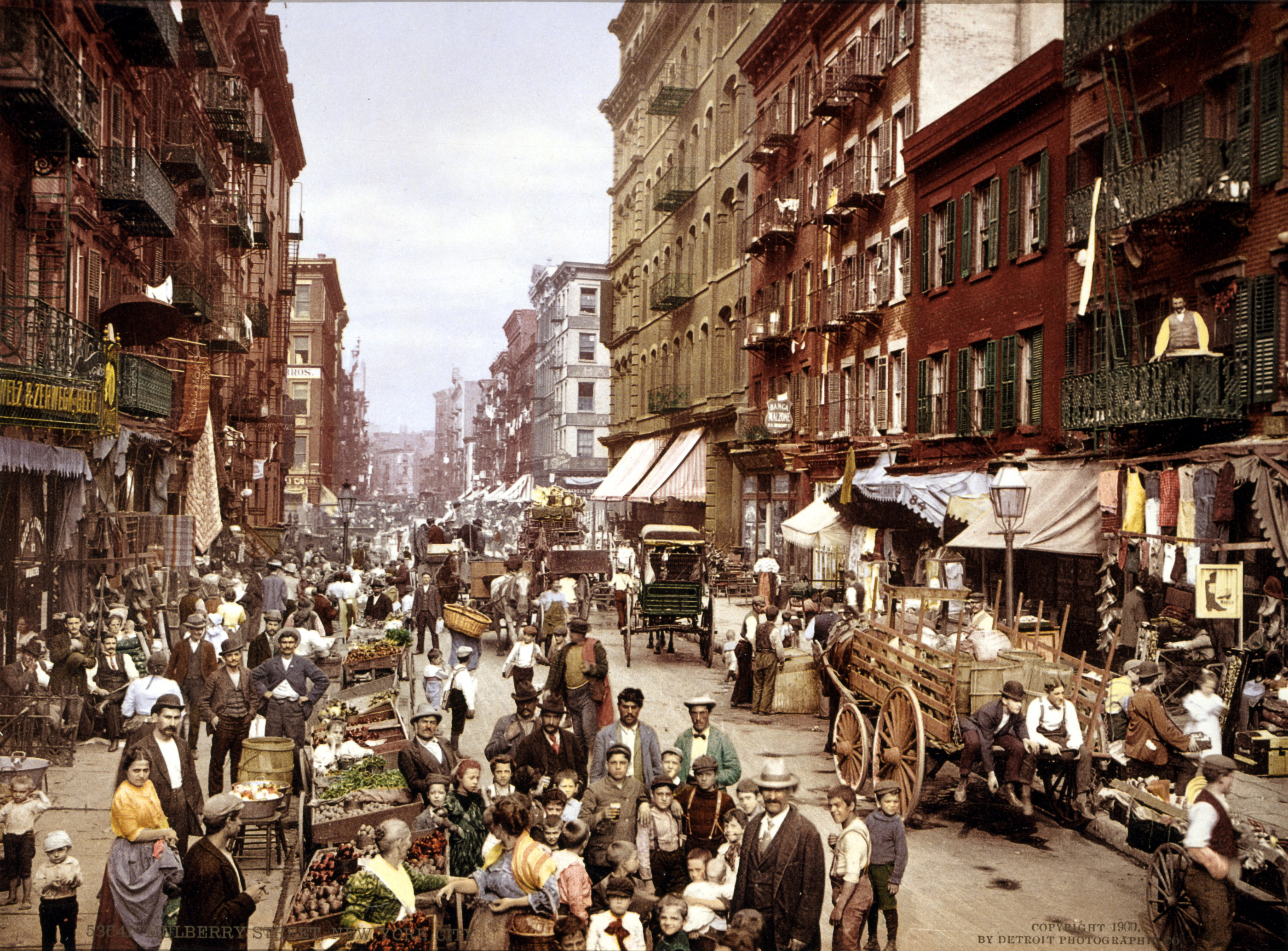
I just love this early picture of Little Italy.

I’m also curious about the mutual intelligibility of Ladino for native Spanish speakers. (The lyrics for anyone who wants to check it out.) I feel I can understand much of what Avishai sings (some is actually Hebrew here) with my imperfect grasp of Spanish. I imagine there’s much more cross-over for native speakers. Interestingly, I found this response while looking it up on WordReference:

I a m a native spanish and catalan speaker from Spain, and I just wonder why in the world would someone want to understand some kind’a weird bad-written variation of spanish called ladino.

The commenter is native speaker of Catalan, which is looked at derisively by many native Spanish speakers. WordReference is usually a forum full of people who have a strong respect and understanding of language so it’s amazing to me that someone who speaks a minority language that’s so caught up in controversy would make this extremely hypocritical statement.

Daily Odyssey.

Happy Bloomsday. And Father’s Day, too, I suppose.

One thing I got from James Joyce’s Ulysses was that every day is a long, miraculous trek, no matter how mundane. It’s a wonder that it passes at all. Nothing exceptional really happens in Ulysses, it reads like a day in the life of Leopold Bloom, but it feels exceptional. Even the use of language feels exceptional. And why shouldn’t it? Communication is just as much of a miraculous trek. The amount of effort that goes into speaking a single utterance and transmitting all the information that goes along with that utterance can be dissected for a lifetime. My guess is this plays into Joyce’s strange use of language, and his decision to model a day after the mythical Ulysses’ 10 year journey. Life is as strange as we allow it to be.

At least, that seemed to be the point to me. If there was a point at all. I’d be curious to hear what others’ who’ve read it think.

Smutty sweetness.

*I’m kinda indulging in the parentheses so feel free to skip those parts. You’ll still get the point.

That right there is Allen Toussaint, who has only recently been brought to my attention as a New Orleans legend. I’m disappointed that I didn’t know of him until now. There’s something really great about the sounds that come out of New Orleans, and my hunch is it’s the blending of cultures, but it doesn’t seem to travel very far past the boundaries.

The reason I’m really posting is because this is because it’s a good example of the life of a song. This is actually a Jelly Roll Morton composition yet it sounds incredibly fresh, even when being played by a 71 year old. He doesn’t actually change all that much, either. It’s still clearly a blues. He adds some runs that you’d sooner hear Chick Corea play or a classical pianist, but they work. He throws in some minor 2nds, like the ones around 4:57, but sparingly, and those have always been pretty acceptable in blues, at least melodically. There might be some perfect fourths in the lower two voices at times, too, but that’s enough technical jargon.

The point is, he’s playing with 70-80 years of history between himself and Jelly Roll. Because others between the two kept the song going, kept making it fresh, it gave him a chance to continue it with all the influences he’s accrued in his own lifetime. It’s another version of folk music traditions, where the song doesn’t even belong to the composer because no one can remember who the composer was. It simply is.

(This is sort of echoed by other people. Kurt Cobain once said something like a song is never as good/the same as the 1st time it’s played. Kaija Saariaho–and Nico Muhly, too, I believe–once said she just composed her music, then it belonged to whoever was performing it. [Sorry, can’t find links, let me know if you can, or can correct me.] A pretty diverse crowd. It’s a good reminder that, really, music is a temporal experience that exists as something new with each repetition, even if the repetitions are reminders of earlier experiences.)

The title is a reference to the Jelly Roll version, which included words:

(Honestly, I like the lyrics a lot. Just remember, he came up in Storyville.)

(And for those interested in the technical stuff, there are definitely some strong impressionist influences in Toussaint’s playing. He often uses a 3 against 4 run that sounds straight out of the 1st part of Debussy’s Deux Arabesques and employs pentatonic scales that aren’t exactly the blues scales. The latter is something Debussy got from Asian music–or Russian music which got it from Asian music?–so Toussaint is sorta bringing the whole world together here.)

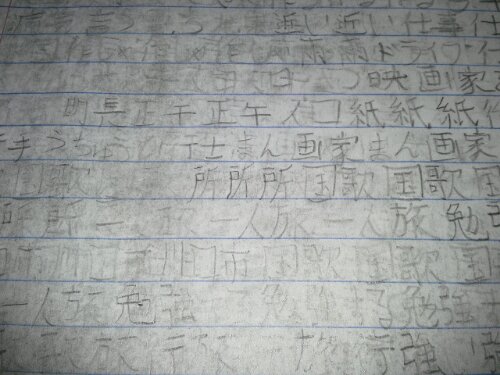
Smudged pencil.

image

Sometimes my notebook is metaphorical. I write down a bunch of words that are barely understandable, hoping to build up a meaningful list, but I forget some things and others simply vanish as the adjacent pages rub together, filtering down to a few leftover segments.

I like that 歌 (uta or /ɯtɐ/) stuck around. It means song.

Or maybe I just need to buy better notebooks.

A tribute to timpanis.

It’s a shame that the timpani isn’t used more outside of classical music. A well placed timpani can be extremely effective. For instance, Roy Orbison’s use of it in his famous song You Got It:

To me, the timpani makes this song feel epic (along with simply being a great song otherwise). It adds a sort of drive to the chorus that simply wouldn’t work if a crash or something else was used in its place. In fact, a crash is used at the same time but it doesn’t serve to separate this section from the pre-chorus because it’s already been employed. There’s nothing novel about the sound of a crash at that point in the song.

I thought about this because of CocoRosie’s song Lemonade:

They use a timpani throughout and it immediately jumped out of me. It wasn’t that it was out of place, it’s just that it works so well. They manage to use it in a melancholic way and a more aggressive way. It adds atmosphere, maybe because it’s so reverberant, and capable of augmenting the chord changes because it’s actually pitched.

What I’m trying to say is, “I like timpanis.”

There’s a linguistic tidbit to this. Timpani is actually the plural form from the Italian word timpano. I’m curious about how often this happens with Italian loan words. Another obvious example is panini which is the plural of the Italian word panino. I’ve heard people complain about the pluralization of that one but even when I lived in New York I never heard anyone order a panino.

All that is to say that it’s fun to just add an s without any regard to the origins of these words. Fuck it, English is a plural imperialist. We’ll conquer your words and add our s’s.

And I’ll leave you with another famous timpani piece from a more traditional genre used in a non-traditional way:

« Older posts Newer posts »

© 2026 Josh McNeill

Theme by Anders NorenUp ↑