Author: Joshua McNeill (Page 10 of 20)

Sociolinguist | Specialist in French & Creoles, Race & Ethnicity
Sociolinguiste | Spécialiste en français et créoles, race et ethnicité

Esoteric profitability.

I am obviously not prone to buying music but I’m honestly considering buying Ashtray Nagivations’ new release Cloud Come Cadaver. Why? Because there aren’t nearly enough people listening to this stuff to make it find-able online for free. I’ve tried already, and I’m good at this; I’ve been pirating software since BBSes (I’d say music since then but this was before MP3s existed).

This creates a weird sweet spot in selling-your-music land. On the one hand, if you’re just completely unknown, you’ll be lucky if people find your music to begin with; while if you’re fairly well known but not being played in shopping malls, your music will probably be too easily accessible to the people that listen to it for them to buy it. (I’m leaving out if you are one of those people whose music is played in shopping malls because they’re part of a whole different world of music business issues.)

But you have this place between completely unknown and well known among music lovers only that allows you the option of actually selling music. I come across it more and more as my tastes continually lead me to noise, glitch, and contemporary classical music. The last category is almost uniformly inaccessible to the file-sharer, with the exception maybe of Nico Muhly and the NOW Ensemble, the latter of which has actually offered their albums for free at one point. Nope, when my Soundamus feed tells me a new Kaija Saariaho release is coming out, I don’t even bother adding it to my calendar because I know I could only listen to it if I bought it.

That last point typifies a couple issues. First, Ashtray Navigations is only selling the album for ₤3 and I imagine they’d be pretty lucky to get even 500 sales (correct me if you’re in the know). That’s ₤1,500. I’m not sure how they go about their recording process but if it’s anything like what I’ve previously described about packaging and distributing music, that money could be 100% profit. Even at that, though, it’s not enough to go into making music as a full time job by itself. They could maybe raise the price but it’s likely that a curve would be created where the more the music costs the fewer people there are that will buy it and so the profits will even out. I certainly wouldn’t pay $10 for the album, because I can still listen to their old music and save that money for bus fare. This is reality for a lot of consumers, which is the second issue typified here. I get probably 10 newly released albums every month but there’s no way I could afford a $100 bill each month. I buy store-brand peanut butter. I can afford $3 a month for a single album that I particularly want to listen to that isn’t available through any others means, though.

I think Ashtray Navigations’ Bandcamp is pretty fair, but the above often leads me to the “lets just make all our music free for fuck’s sake” conclusion. It reminds me of a thesis project a classmate of mine was recently proposing. She’s an economics major and wants to look into altruism in the market and one of the points she made while discussing it is that studies have shown that people will offer their resources much more willingly when it’s not made into a business deal. Blood donors, for instance, were more willing to donate if they weren’t offered cookies or money or anything in return. Maybe this is why those pay-what-you-like albums seem to be turning into a thing these days.
Mothers’ mother’s Mothers Day.

I’m pretty sure the title of this post could be paraphrased as the Mother’s Day of all the mothers that belong to all the mothers out there.

A friend of mine just mentioned Mother’s Day to me through text and I had to pause when writing back because it seemed that any version of mothers/mother’s/mothers’ would make sense when talking about the holiday. This is a topic that John Wells has blogged about at least a few times. He likes to go on tirades against apostrophes, and I think for good reason. They’re often unnecessary when context will due and the phonetic realization of each version is the same. If we can handle this in speech, why not in writing?

Maybe because no one is likely to understand a title like Mothers’ mother’s Mothers Day in speech. If someone actually uttered this phrase, I’m sure their listeners would need to ask for some clarification. In this case, the orthography actually has the option to disambiguate without any clarifying questions. So what if we end up writing things “wrong” because of confusion over apostrophes and polysemy: a purpose is still served.

This reminds me of the debates over Japanese writing that I’ve blogged about before.

The process of breathing.

It may not be too obvious what’s going on in this music but all those sounds are coming from one person and mostly from that one person’s voice. She uses a loop station which allows her to record short bits of sound and have them to continue playing immediately after. They can be left alone or stopped and started back up and additional sounds can be recorded and looped over top the loops that are already playing. Essentially, she has the ability to be a whole acoustic band through electronic means.

What seems important here is process. Minimalist composers like Terry Riley or Steve Reich have been playing with this idea since the 60s at least but not in this way because the technology just wasn’t there. What I mean by process is that we’re essentially hearing a song being composed on the spot. In fact, Julianna Barwick has explicitly stated that her music starts out as improvisations. Improvisation is a bit different though. In that form, the music can change drastically at any point whereas, in process music, that’s not possible/wanted. It’s repetitive instead. She can’t suddenly change everything that’s being played all at once, say, if she wanted to modulate to a different key. What you’re hearing is simply one musical phrase that repeats and only changes subtly as layers are added and removed. It creates a sense of calm, because you know what to expect, but also a sense that something is happening.

To me, more poetically, it’s like breathing. Very long, deep breathing. The music naturally builds, each new layer both hides and is supported by the previous layer until you end up with a mass of sound that tends to gradually dissipate as layers are then removed again until all that’s left is that original line of sound in isolation. I imagine each song as one incredibly drawn out breathe. I’ve been thinking a lot about breathing lately.

For those who want to see how she does it:

Preconceptual tracking of a primitive perceptual individuality.

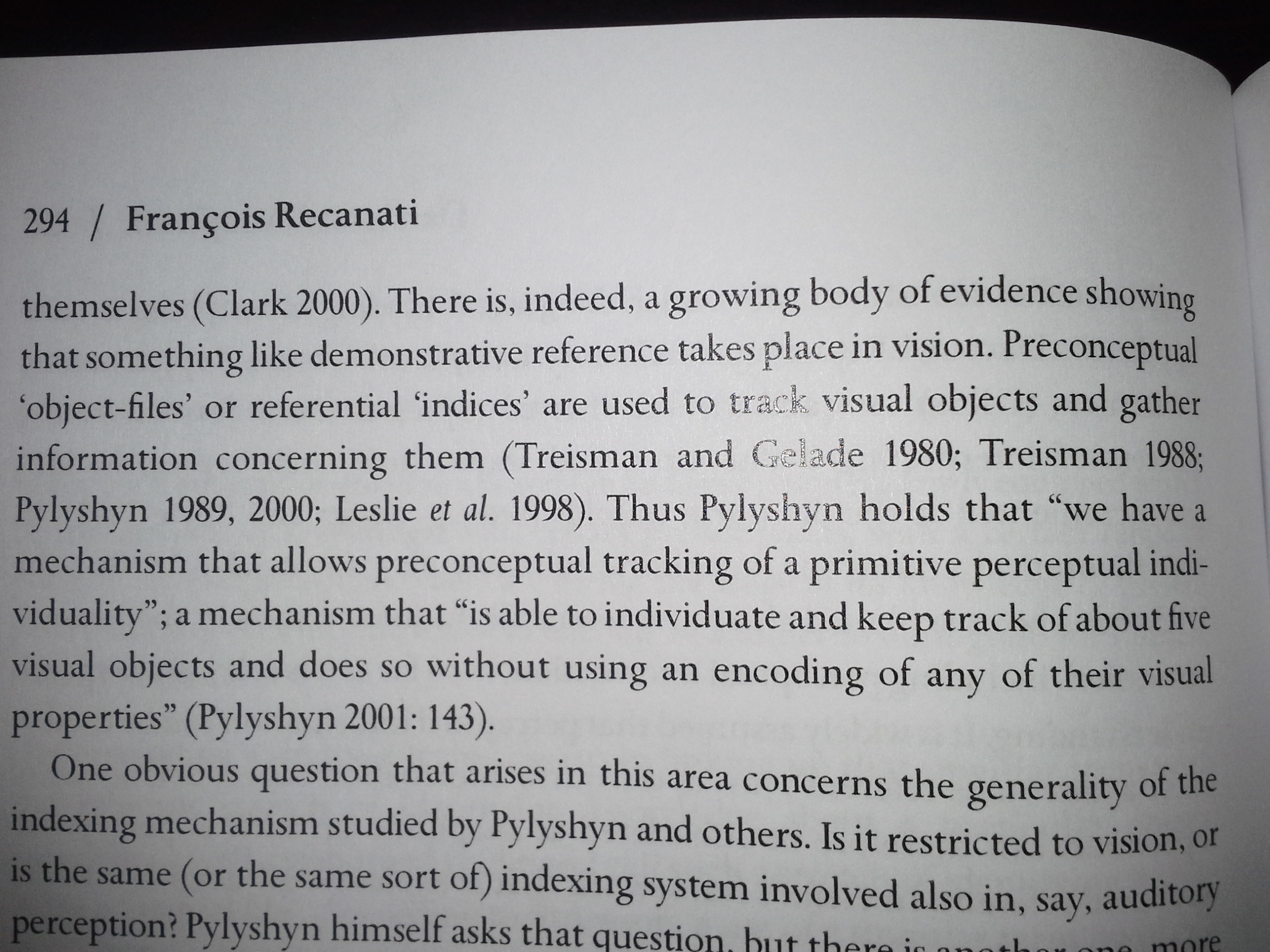
That phrase is only vaguely intelligible to me even with context so I’m not gonna try to explain it. It comes from Recanati’s Deixis and Anaphora:

Visual Indexing

The point, though, is pretty clear, and interesting. Apparently some five objects in your perceptual field can be held in some sort of automatic index that can be drawn from when making sense of your surroundings. Recanati brings this up when talking about pronouns and how it’s possible for us to make sense out of a sentence like:

Yesterday, my brother talked to the policeman about the burglar we saw. He told him he thought he had escaped, but the policeman would not believe him, arguing that someone was awake, and he would have seen the burglar if he had left.

The pronouns used here are somehow not confusing even though they could each refer to various people in the context. Recanati suggests that there is a tracking mechanism for indexing pronouns analogous to Pylyshyn’s visual tracking mechanism. What interests me more is the last sentence about an auditory analog, though. I’m pretty sure I’ve come across ideas like this for music as reasons why 12 tone music sounds completely random to most people, for instance: a melody that arbitrarily hits all 12 pitches of an octave before repeating is simply too long to keep in memory and build a gestalt from. It might explain why noisy busy music, with many things happening at once, is sometimes unnerving as well.

Think I’m gonna file this as yet another thing I’d like to look into but will never ever have the time for.

Asymmetry.

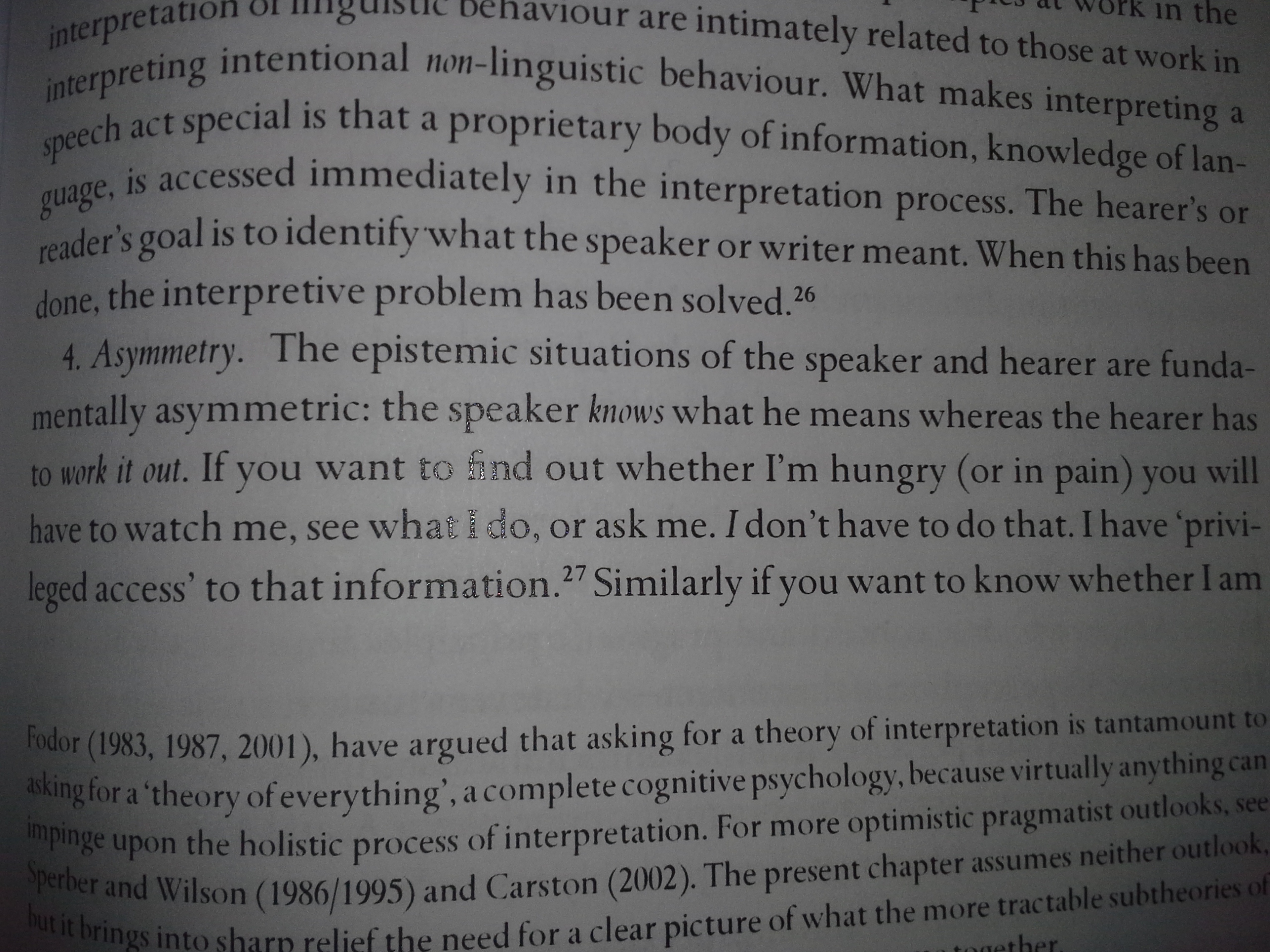
#4, from Stephen Neal’s Pragmatism and Binding:

I’m increasingly convinced that the point of semantics is to prove that we have no idea what anyone else means by anything. Communication seems to be just coincidental and we’ve only convinced ourselves that it’s real. This is why we have art. What need would there be for art if we could actually understand each other? Art is like desperately trying to claw our way into someone else’s being. It’s like a Gricean implicature, letting us know that we fail to connect on a regular basis. Or maybe I’m just not understanding what the author is saying here…

Eardrum knots.

From around 4 minutes in until the end, this track feels like it’s massaging your eardrums. It only works if you’re using headphones or have your speakers angled so that stereo sound actually sounds stereo. (Excuse the palindroming.) I imagine this is how deaf people can enjoy music.

Belong originated in New Orleans, by the way. Sooo, if anyone has any idea whatsoever where this kind of music gets played in NOLA, please let me know.

Inescapably human.

I’m a big fan of last.fm. I’ve discovered so much amazing music through the related artists section and it helps me generate RSS feeds for shows in my area that I’d like and even feeds for new releases via Soundamus. It’s the perfect organization tool for someone who listens to entirely too much music (seriously, it’s difficult to keep track of all 1,500 artists I like). It also occasionally teaches me something I didn’t know like it did the other day when I came across this picture:

Anton Webern: Wearer of Flower Hats.

You probably don’t recognize this guy. Hell, I wouldn’t recognize him if I didn’t know who I was looking at beforehand. He’s Anton Webern: early 20th century Viennese composer of works such as this:

You may notice that he looks a bit different in the image used for the video. That’s how you normally see this guy, as a stoic intellectual writing music based purely on theory and dissecting stray cats for the sake of science in his spare time. (The latter never happened, but shouldn’t it have?) Even the name of the composition is sterile. Five Pieces for Orchestra? Yes, I guess that’s what they are. He’s not someone we’d expect to be creating flower arrangements.

This is what’s so striking to me about the picture, though. This one image summarily destroys all our preconceptions about what this guy must have been like. It’s tempting to listen to his music and read about him and look at the pictures most commonly used to represent him and determine that he has no soul, that’s he’s barely human, but he clearly is.

This is something that I think happens every day to just about everyone. You look at the people around you and instantly develop ideas about what they are, often overlooking who they are. Even the ugliest, most hateful people are still human; there’s simply no escaping it.

Beating.

Beating: simple waveforms standing close enough together to create unsteady vibrations.

You don’t really notice that each one exists until they get that close.

Don’t ask me what the tree has to do with anything.

« Older posts Newer posts »

© 2026 Josh McNeill

Theme by Anders NorenUp ↑